Publikationen

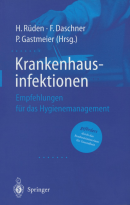
Empfehlungen für das Hygienemanagement

Ein hilfreicher und informativer Leitfaden für die Surveillance von nosokomialen Infektionen. Im Leitfaden Krankenhaushygiene geben führende Fachexperten kompetente Antworten auf alle Hygienefragen aus der Praxis für die Praxis.
Die im folgenden aufgeführten Publikationen stammen aus den Instituten des NRZ. Die Liste wird periodisch aktualisiert und erhebt keinen Anspruch auf Vollständigkeit.

Aghdassi S.J.S., Saydan S., Pfäfflin F., Stegemann M.S., Theloe A., Behnke M., Peña Diaz L.A., Gropmann A., Geffers C., Piening B., Hansen S.
Broad-spectrum and Watch antimicrobials are commonly used to treat hospital-acquired infections in German acutecare hospitals: results from the 2022 national point prevalence survey
Antimicrob Resist Infect Control. 2025;14(1):90.
Aghdassi S.J., van der Werff S.D., Catho G., Brekelmans M., Peña Diaz L.A., Buetti N., Rüther F.D., Teixeira D.,Sjöholm D., Nauclér P., Behnke M., van Mourik M.S., PRAISE-HOB working group
Hospital-onset bacteraemia and fungaemia as a novel automated surveillance indicator: results from four Europeanuniversity hospitals, 2018 to 2022
Euro Surveill. 2025;30(24)
Rüther F.D., Grisold A., Wechsler-Fördös A., Gropmann A., Behnke M., Hansen S., Geffers C., Aghdassi S.J.S.
State of infection prevention and control in Austrian hospitals: data from 81 hospitals completing the WHO InfectionPrevention and Control Assessment Framework (IPCAF)
Antimicrob Resist Infect Control. 2025;14(1):18.
Saydan S., Schwab F., Holstiege J., Bätzing J., Behnke M., Schneider S., Clausmeyer J., Gastmeier P., Geffers C., Maechler F.
Surveillance of Clostridioides difficile on hospital admission and outpatient antibiotic use in Germany-a 9 yearecological analysis
J Antimicrob Chemoth. 2025;80(3):817-824.
van der Werff S.D., van Rooden S.M., Henriksson A., Behnke M., Aghdassi S.J.S., van Mourik M.S.M., Nauclér P.
The future of healthcare-associated infection surveillance: Automated surveillance and using the potential ofartificial intelligence
J Intern Med. 2025;298(2):54-77.